
Last Updated on November 22, 2025
This project began with a simple goal. The dealership wanted to sell more cars without raising its advertising budget. At first glance, it looked like a campaign level problem, but it quickly became clear that the real opportunity was in the entire sales funnel, not just the ads.
To reach the results we wanted, we had to rethink everything. We had to align marketing with the sales process, improve the data flowing into the CRM, and give the sales team information that actually helped them close more deals. Once both sides started working together, the numbers began to move in a way the client had not seen in a long time.
It was a fascinating case study to write, let alone to accomplish. We got to use old tricks, like passing the search keyword to the CRM together with the lead details to inform the sales representative about what the user searched for (like we did here), tracking down the funnel events to re-educate the conversion tracking algorithm about actions that are more significant than others (like we did here), and, of course, setting up the entire account from scratch to represent the business priorities and profit margins per model.
TL;DR: The Results
- Lead volume increased by 1.7X with no change in budget
- Sale rate improved by 3.2X, from 1% to 3.2%
- Combined effect created a ~450% uplift in total sales
- Overall performance increased by 5.44X without raising ad spend
About The Client
The client is a medium sized car dealership in Georgia, United States. They specialize in customized executive and luxury cars. They have an experienced sales team and a customizable CRM that can pass offline conversions back to Google Ads and Meta.
The Baseline
Before we worked together, the dealership spent around $25,000 per month on Google Ads and Meta Ads. They acquired leads at around 170 dollars each, not amazing, but far from being a real problem. The problem was the conversion rate. Only about 1% of leads turned into a car purchase, which meant the cost of acquiring a paying client was about $17,000. Ouch.
On top of that, the low lead-to-sale rate frustrated the sales team. They spent time on prospects who were unlikely to buy. They received about 4.5 leads a day on average, which made it hard to keep the sales floor active and motivated.
Campaign Set Up
The account used automated bidding, but it was optimized for leads rather than sales. This meant that Google and Meta treated all leads equally, including leads who had no intention of answering the phone. All ads used the same creative, which lowered CTR and quality score and increased CPC.
The Client’s Sales Funnel
The dealership’s sales process had several steps. It usually started with an initial phone call, then a face-to-face meeting to understand the car preferences and budget, a tour of the parking lot or showroom, a credit check for financing, and finally the purchase and handover.
Analysing the Performance
We reviewed the previous months of data to identify the quickest and strongest opportunities for improvement.
This is the exact dataset we worked with.
Funnel Performance Before Optimisation
The data below is from the last 1000 leads before we started working with the client.
| Funnel Stage | Count | Percent of Previous Step |
|---|---|---|
| Answered the initial call | 920 | 92% |
| Booked a meeting | 480 | 52.17% |
| Showed up to meeting | 350 | 72.9% |
| Second meeting | 130 | 37.14% |
| Started credit check | 20 | 15.38% |
| Purchased | 10 | 50% |
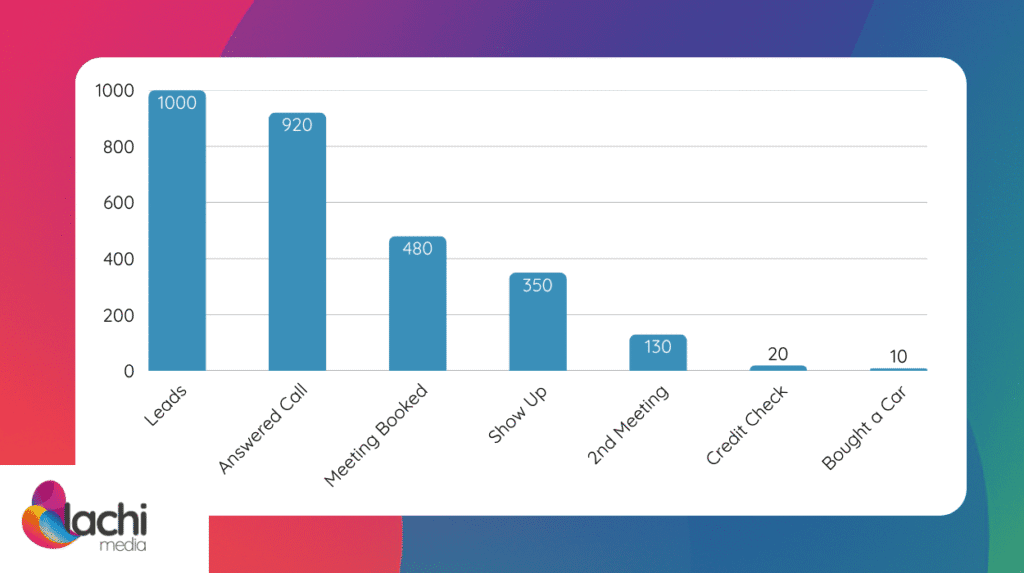
We immediately noticed that the initial call answer rate was unusually high, indicating that the sales team was putting real effort into callbacks and was responsive and active. The weak points were the meeting booking and attendance stages. These numbers made it clear that the user intent was not strong enough and that the reps did not have the information they needed to move the conversation forward.
A 1% purchase rate at $ 170 per lead gave the dealership a customer acquisition cost of $17,000. This was the baseline we needed to improve.
The Plan
First, we knew we could increase the number of booked meetings and the attendance rate if we let the sales rep know what the user originally searched for or which car they viewed on the site before submitting the lead. Passing the exact search keyword into the CRM helped the reps adjust their approach and feel more confident about the conversation.
Next, we started reporting down funnel conversions back to Google and Meta. We wanted the ad platforms to understand the entire funnel, not just the lead event. We documented every click ID in the CRM and reported each action using Google’s and Meta’s APIs.
The idea was simple. At the start, the campaigns were optimized for leads because that was the only conversion firing. Once we built the full funnel tracking, we changed the primary conversion to answered calls. After the numbers stabilized, we shifted to scheduled meetings. Later, we shifted to users who showed up. This process continued down the funnel.
This helped us improve lead quality because the algorithms were now trained to focus on people who made real progress, not people who simply filled out a form.
The Set Up
We rebuilt the search campaigns based on car tiers. This dealership sells high end models, so we used a structure based on make and tier. Campaigns targeted executive and luxury cars, and each make had campaigns with ad groups for specific models and a general ad group for the make.
On Meta, we created audiences from past clients segmented by make and tier. We used lookalike audiences to expand. Once the algorithm received strong signals from accurate data, we also used broader audiences.
For the ads themselves, we did everything possible within Google’s limitations. We mentioned makes and models when possible, added relevant ad assets, used dynamic keyword insertion and emphasized variety and white glove service. The copy matters, but what matters more is relevance between the keyword, the ad and the landing page.
Improving the Sales Process
Passing the keyword to the CRM allowed the reps to adjust their script. The idea was to mention the model casually rather than directly.
A typical opener was:
Hi, I saw you were looking for a car, right
My name is XYZ from the dealership. Do you know what you were looking for? To be honest, we just got an amazing car that matches what you searched for and it passed our QA process with a perfect score. If you want, you can take it for a spin before anyone else sees it.
This approach made the conversation feel natural rather than scripted. It also improved rep motivation. Once they saw better meetings and better results, they pushed harder on their own.
The improved campaign structure also improved lead routing. Reps who specialized in certain makes or tiers received more relevant leads.
The Results
The entire process took around five months, with the biggest improvement happening in the fourth week.
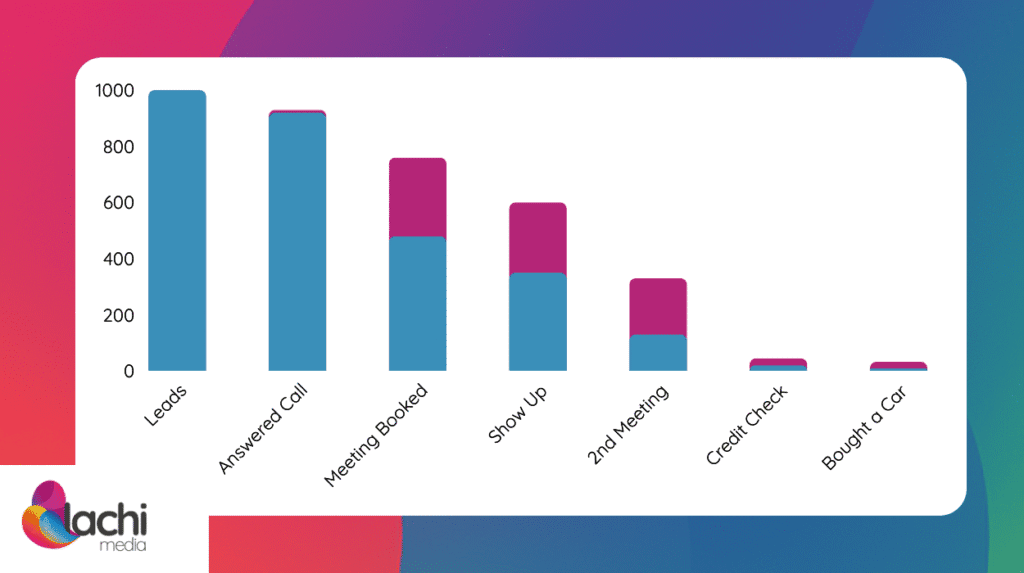
Here is the before and after, based on the same 1000 lead sample size.
Results Summary Table
| Funnel Stage | Before | After |
|---|---|---|
| Answered the call | 92% | 93% |
| Booked a meeting | 48% | 76% |
| Showed up to meeting | 35% | 60% |
| Second meeting | 13% | 33% |
| Started credit check | 2% | 4.5% |
| Purchased | 1% | 3.2% |
Lead volume and CPL
The cost per lead dropped by about 42%.
This meant that the same budget that previously generated 100 leads now produced around 170 leads.
Lead volume increased by roughly 70% without changing the budget.
Combined effect
With a 1.7 times increase in lead volume and a 3.2 times higher sale rate, the dealership’s performance changed entirely – bringing 5.44 times more sales for the exact same budget, turning their digital marketing profitable for the first time since they started it.
More leads and a much stronger funnel created a meaningful lift in actual sales, all without increasing the advertising budget.
Most of the improvement happened early in the funnel, right after the initial call. Once the reps received intent data from the keyword the user searched for, their motivation increased, and the improvement continued throughout the funnel. This created a snowball effect that carried all the way to the final sale.
The Aftermath
The dealership became profitable again after losing money on ads for a long time. The next step is to grow their cash reserve, then double down on what is already working by introducing more makes and models that match the user profiles we now know convert well.
Key Takeaway
This project showed how powerful it is when marketing and sales work together instead of arguing about lead quality. Improving the funnel motivated the reps and the reps’ improved performance motivated the campaigns. Once everyone pushed in the same direction, performance started improving on its own and the results began to compound.