
Last Updated on October 11, 2026
This is quite an interesting case study we’re excited to share.
A prospect came to us with a clear and challenging goal: multiply the revenue of their e-commerce store by five in less than a year, without spending more on ads.
It was a big challenge, and I’m proud we beat it. I’m even more excited that we were able to do it in about half the time, reaching the goal in under six months instead of a full year.
TL;DR: The Results
In under six months, we turned the unprofitable Google Ads account of an online music store into a profitable, revenue-generating machine.
The client was spending about $15K/month on Google Ads and barely breaking even in revenue, which meant they were actually losing money on many of the sales they made.
With the same monthly ad spend, the client went from losing money on sales to consistently reaching 500%+ return on ad spend. Profits doubled within the first week, break-even was reached in about two months, and by month six the account was generating five times higher returns without spending a dollar more.
| Stage | What Changed |
|---|---|
| Starting point | Around $15K/month in ad spend, barely breaking even in revenue, |
| Week 1 | Profit doubled after reallocating budget to better opportunities |
| Month 2 | The account reached break-even in gross-profit |
| Month 6 | The account reached 500%+ return on ad spend |
| Budget | Stayed roughly the same throughout the process |
About the Client
This is a musical instrument store operating in the US.
They were already spending around $15K a month on Google Ads, but they were barely breaking even in revenue. Once product margins were taken into account, this meant they were losing money on many of the sales they made.
It’s not unusual for e-commerce stores to lose a bit when they first start with online advertising, especially while the account is still learning. But in this case, it was more than a bit, and there was no clear sign of improvement.
The account was getting sales, but the sales were not profitable enough.
Day One
We started by analyzing the account.
The first thing we wanted to understand was where the budget was actually going. Which products were getting spend? Which products were generating revenue? And more importantly, which products were actually making the client more profit?
That last part mattered most.
Revenue alone can be misleading in e-commerce. A campaign can look like it is working because it brings in sales, but if those sales come from low-margin products, the business can still lose money.
We were able to double the profit almost overnight just by focusing on the quick wins and reallocating budget toward the products and categories that made more sense.
Doubling profit, though, wasn’t enough.
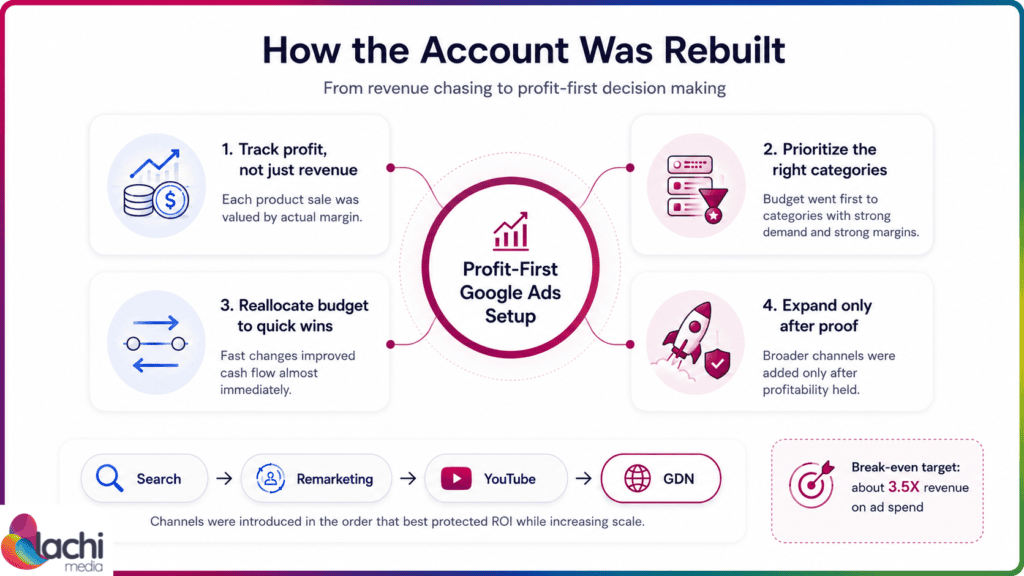
In order to break even, we needed to generate about 3.5X of our ad spend in sales. The exact number varied a little between categories, but most of the account needed to perform around that range.
So we decided to start from scratch, but still use the data the old campaigns had already collected.
Tracking Setup
Making sure that tracking is set up correctly is a vital part of any Google Ads account, but it is often overlooked.
In this case, the basic tracking was working. The account could track sales and revenue. But that was not enough for what we needed.
We wanted to add another view-only conversion that tracked the profit from each product sold.
In that conversion goal, 100% ROAS meant break-even.
That made a huge difference because each product had its own profit margin. We wanted to take advantage of products that were easier to sell, but still had higher-than-average profit per unit sold.
We also used that conversion to manually tweak keywords, ads, bids, and budgets.
| Before | After |
|---|---|
| Optimized mostly around revenue | Added a profit-based conversion view |
| Sales were treated too similarly | Products were judged by actual margin |
| Budget followed revenue | Budget moved toward profitable categories |
| Harder to know what was worth scaling | Easier to see which products could grow profitably |
The Plan
We knew that in order to reach the 5X profit goal and still be able to scale, we had to divide and conquer.
We divided all the products the store sells into categories, then sorted those categories by a combination of search volume and profit margin.
Apart from setting up the obvious Shopping campaign, each category got its own set of campaigns: Search, YouTube, remarketing, and GDN.
But we did not want to go broad from day one and narrow down later.
Instead, we decided to “re-educate” Google’s algorithm around our new, real conversion goal: 500% return on ad spend.
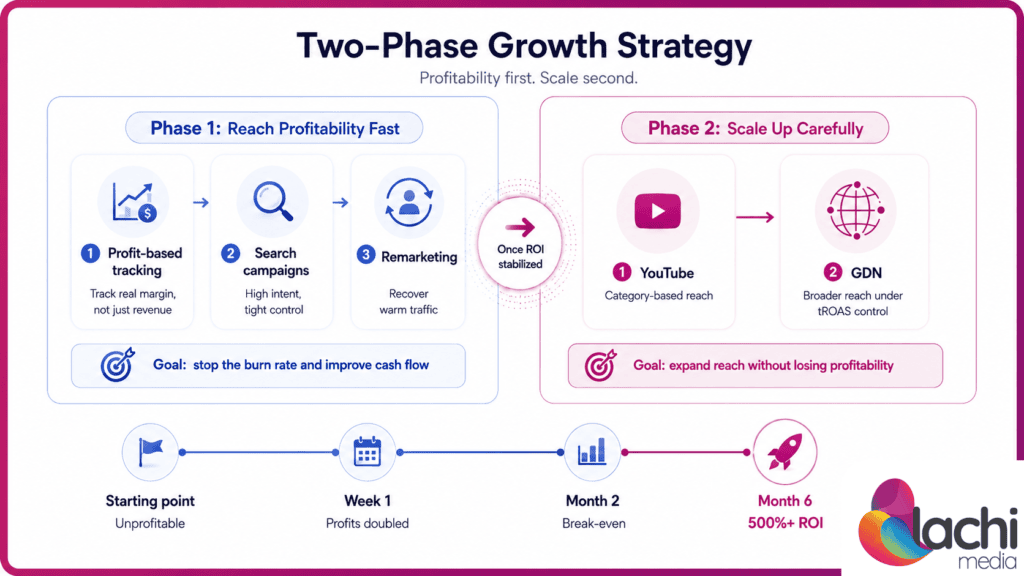
The plan had two phases.
First, we launched Search and remarketing to reach profitability as fast as possible. Then, after reaching the initial ROI goal and keeping it stable for a few weeks, we expanded with video and display campaigns.
The idea was simple: train the account on the right signals first, then scale.
Phase One: High ROI as Fast as Possible
The first goal was to stop the burn rate and improve the client’s cash flow.
At this stage, we did not need to reach everyone. We needed control. We needed to make sure the money went toward searches, products, and users that had a much better chance of turning into profitable sales.
Search Campaigns
Search was the first type of campaign we set up because it gave us the most control over bids, keywords, ads, and targeting.
Researching keywords manually gave us an advantage in many of the auctions. It allowed us to create highly relevant ads for the exact searches we wanted to appear on.
That level of control was important because we were not just trying to get more sales. We were trying to get more of the right sales.
Remarketing
Dynamic remarketing is a must in most e-commerce accounts, and this case was no different.
But we did not stop there.
In addition to dynamic remarketing, we manually created audiences for each product category. The goal was to drive users back to the most relevant category pages, not just send everyone back to the site in a generic way.
We also made sure that users from this campaign saw products that were both top-selling and had strong profit margins.
That way, remarketing was not just recovering traffic. It was recovering traffic in a way that still supported the profit goal.
Phase Two: Scaling Up
Now that the client was profitable, we could start scaling.
This is where the order mattered.
If we had started with broader campaigns before fixing the account, we probably would have given Google more room to spend money badly. Instead, we first trained the account around the right goal, then expanded reach once the account had a better foundation.
YouTube
YouTube is a rare combination of very wide reach and strong targeting.
Because it is part of Google’s ecosystem, we could use it to reach relevant audiences while still keeping the campaigns connected to the product categories we cared about.
We created lists of channels in each category and sent those users to the relevant category pages on the site.
This setup is a bit tedious, but the results are usually worth the effort. It creates a much cleaner connection between the audience, the message, and the landing page.
GDN
The last campaigns we launched were GDN campaigns targeting broader audiences.
We created custom audiences using keywords and search terms from the Search campaigns, as well as URLs from the top 10 organic results for each keyword we used.
We started slowly and did not allow Google to target users outside our target audiences at first.
Gradually, we enabled more extended reach while relying on a firm tROAS goal to limit irrelevant and unwanted clicks.
Campaign Rollout
| Channel | Why We Used It | Phase |
|---|---|---|
| Search | High-intent traffic with tight keyword and bid control | Phase One |
| Remarketing | Bring warm users back to relevant category pages | Phase One |
| YouTube | Expand reach while keeping category relevance | Phase Two |
| GDN | Broaden reach using search-based custom audiences | Phase Two |
The Results
The setup process took about two months.
During those two months, we reached break-even and started showing signs of profitability at the scale we wanted to reach.
From there, we kept tweaking and optimizing daily to improve profitability without limiting scale too much.
After six months, we hit the target of multiplying the initial return by five.
Despite the much higher return, we were still able to scale because of the setup we chose to implement. The account kept the same general budget level, but the money was being spent on much better opportunities.
| Timeframe | Result |
|---|---|
| First week | Profit doubled |
| About 2 months | Break-even reached |
| About 6 months | 500%+ return on ad spend |
| Ad spend | Stayed around $15K/month |
Why It Worked
The account worked because we changed what we were asking Google Ads to optimize for.
Before the rebuild, the account was mostly looking at revenue. After the rebuild, we gave it a better structure and a better signal.
We tracked profit, prioritized categories by margin and demand, launched the most controlled campaigns first, and only expanded reach after the account had already proven it could hold profitability.
Getting these results is not unheard of, but it does require a lot of cooperation from the client. You need clean data, enough patience to rebuild properly, and the discipline not to scale before the account is ready.
It’s always great to see a client grow this fast with highly profitable campaigns, and we’re already working on the next plan to expand even further.
Want better returns from e-commerce advertising?
Let’s discuss your margins, campaigns, and what it takes to grow profitably.
Talk to Lachi Media