

Last Updated on October 11, 2026
Local Services Ads are finally moving into Google Ads.
Starting in August 2026, Google will begin migrating selected U.S. advertisers away from the separate Local Services Ads dashboard and into Google Ads. The rollout will begin with a limited group of advertisers before expanding to additional categories and markets through 2027.
Google is describing the migrated campaigns as Performance Max campaigns with a pay-per-lead goal. Despite the name, they will not behave like the standard Performance Max campaigns advertisers are already familiar with.
LSA campaigns will remain keywordless and continue appearing only on Google Search and Google Maps. Advertisers will still pay for valid calls, messages and bookings rather than clicks, so this does not mean an advertiser’s Local Services Ads will suddenly begin appearing on YouTube, Gmail or the Display Network.
The most visible change is that campaign management, budgets, leads and reporting will finally sit inside Google Ads instead of a separate platform. However, Google is also changing some of the bidding, budgeting and reporting controls during the transition.
The interface move is overdue, but an unexpected improvement in lead quality during the closed beta may be the more interesting part of the story.
What is actually changing?
Google is not simply copying the existing LSA dashboard into Google Ads. Several parts of the way Local Services Ads are managed will change as accounts migrate.
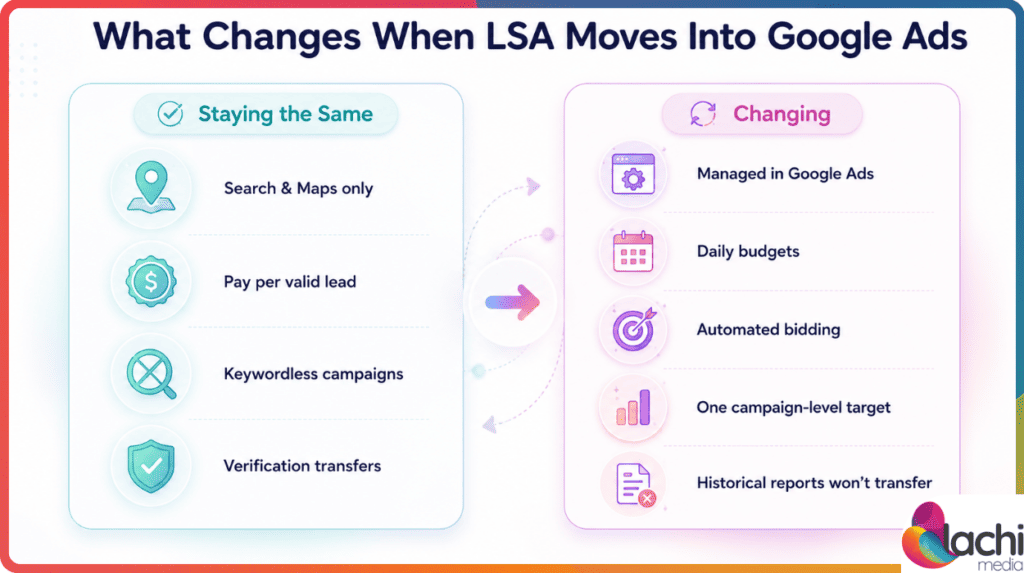
| Staying the same | Changing |
|---|---|
| Ads remain on Search and Maps | Campaigns and leads move into Google Ads |
| Advertisers still pay per valid lead | Weekly budgets become average daily budgets |
| Campaigns remain keywordless | Manual bidding is removed |
| Existing verification transfers | Service-level targets become one campaign-level target |
| Lead history transfers | Historical performance reports do not |
| Services and locations remain selectable | Core business details sync from Google Business Profile |
Weekly budgets will be converted into average daily budgets by dividing the existing amount by seven. This brings LSA budgeting in line with the way other Google Ads campaigns are managed, although advertisers should still review the resulting daily budget after migration.
Manual bidding options, including the ability to set a maximum cost per lead, will no longer be available. Campaigns will instead use automated bidding with one target set at the campaign level.
Advertisers that currently use different targets for separate service categories inside the same campaign will also need to review their structure. Google will apply one campaign-level target across all categories included in that campaign.
One campaign target does not mean every lead has the same value
The move to one campaign-level target could create a practical issue for advertisers whose services have very different values.
Two leads may cost the same while producing completely different business results. One may turn into a substantial paid job, while another becomes a small service call with limited value.
If both services sit inside the same campaign, Google can achieve the target cost per lead while still producing a lead mix that is less valuable to the business.
Google’s solution is to create separate campaigns when categories require different targets. That gives advertisers more control over budgets and bidding, but splitting every service into its own campaign is not automatically the right answer.
Separate campaigns also divide the available data. A lower-volume advertiser could end up with several campaigns that each generate too few leads for automated bidding to learn effectively.
The structure should therefore reflect meaningful differences in the services being advertised, rather than simply mirroring every category available inside LSA.
Historical performance reports will not transfer
The most immediate action advertisers need to take is exporting their existing LSA performance reports.
Google will transfer campaign settings, assets and lead history into Google Ads. Historical campaign reporting, however, will not move with the account.
Once the migration is complete, advertisers will lose access to the old LSA reporting dashboard. Lead records, messages and call history are expected to remain available, but previous performance data will not appear inside the new campaign.
Advertisers should export any information they may need for future comparisons before their migration date. This may include spend, lead volume, cost per lead, service category, location, lead type and historical date ranges used for seasonal analysis.
Google says account administrators should receive advance notice before the migration. It is still safer to export the data early rather than waiting for the final reminder.
An unexpected improvement in lead quality
Before the public rollout, Google ran a closed beta of the new LSA setup.
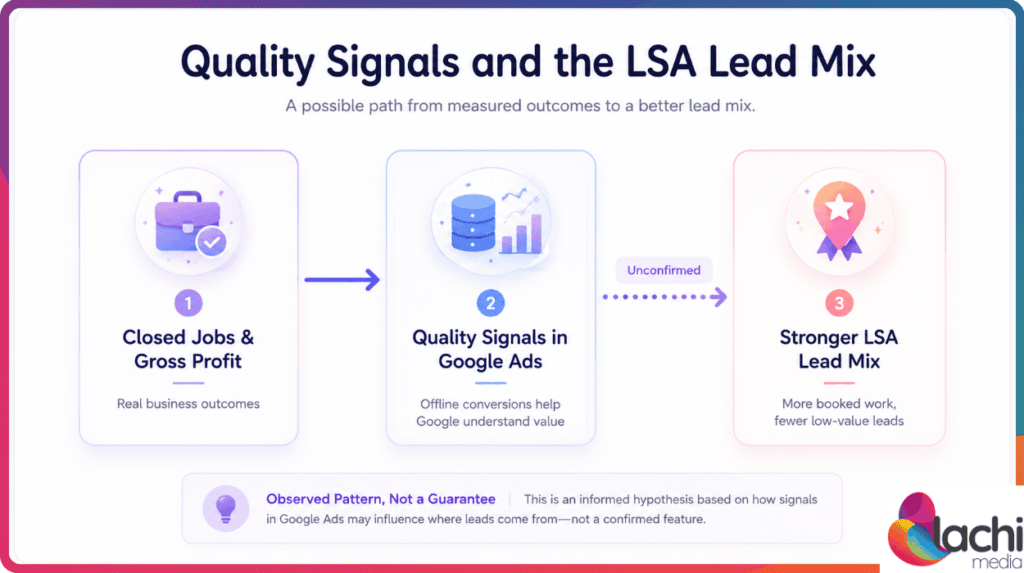
Across several accounts observed during that period, advertisers that were already reporting offline conversions into Google Ads saw an improvement in LSA lead quality after the campaigns moved into the platform.
The size of the improvement varied between accounts, but the direction was consistent. Calls converted into booked jobs more often, and the lead mix shifted away from lower-value service calls toward more substantial paid jobs.
Clients noticed the change quickly, and the account data supported what they were seeing.
Google has not confirmed that offline conversion data influenced LSA delivery during the closed beta. No Google representative has said that this is how the new campaign type works, so the result should be treated as an observed pattern rather than a confirmed feature.
Still, the consistency across several accounts raises the possibility that bringing LSA into Google Ads allows it to benefit from conversion-quality signals already available inside the account.
Google has followed a similar path before
This would not be the first time Google moved a relatively separate advertising product into Google Ads before integrating it more deeply into the wider platform.
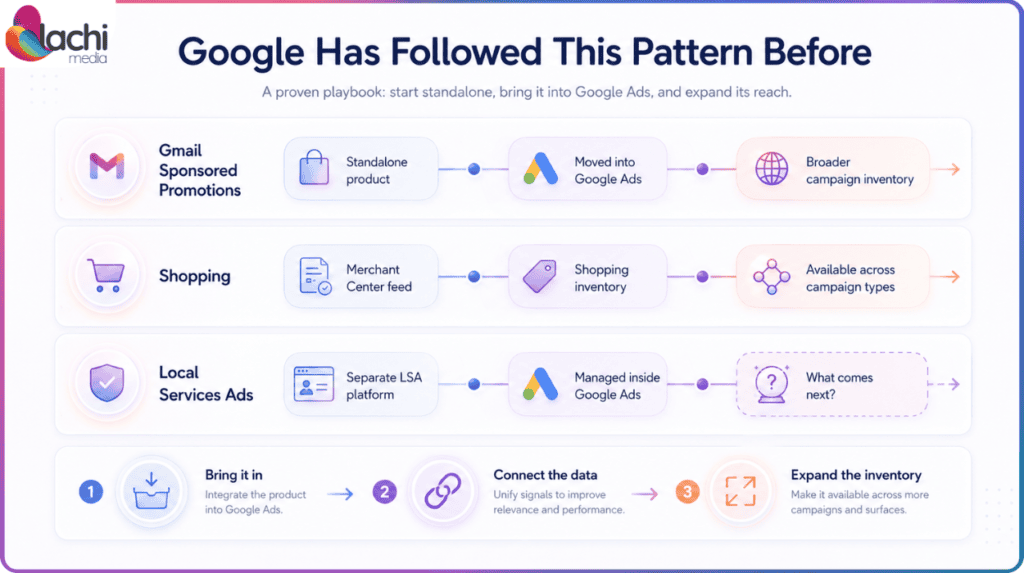
Gmail Sponsored Promotions, usually known as GSP, followed a similar path. The product was brought into Google Ads (then AdWords), later became Gmail inventory inside broader campaign types, and eventually benefited from the same bidding and conversion feedback systems used across those campaigns. And this was in 2015.
Shopping followed a related model. Merchant Center feeds provide the product data, while Shopping inventory can now be accessed through several campaign types.
Nothing in Google’s LSA announcement confirms that the same thing will happen here. For now, the migrated campaigns will remain a distinct pay-per-lead campaign type limited to Search and Maps.
However, moving LSA into Google Ads creates the technical and operational foundation for deeper integration. Over time, Local Services Ads could become less of a standalone product and more of a service-based ad format or inventory type available through the wider Google Ads system.
The pattern would be familiar: bring the product into Google Ads, connect it to the platform’s bidding and measurement systems, then gradually make it available through broader campaign types.
The move also makes it easier for LSA advertisers to expand
There is another likely reason Google wants Local Services Ads inside its main advertising platform.
Many businesses use LSA without running conventional Google Ads campaigns. Local Services Ads are easier to launch because advertisers do not need to build keyword lists, write traditional search ads or understand a more complex campaign structure.
Moving those advertisers into Google Ads removes a major barrier between LSA and the rest of Google’s advertising products.
Once billing information, business details, lead history and campaign data already exist inside Google Ads, launching a Search or Performance Max campaign becomes a much smaller step. An advertiser that previously used LSA as a standalone product is now operating inside the same platform that contains Google’s other campaign types.
That may be convenient for advertisers that want to expand, and it is also commercially useful for Google. The migration gives LSA-only businesses a much clearer path into the wider Google Ads ecosystem.
What advertisers should watch after migration
Most advertisers will naturally monitor lead volume and cost per lead after the transition. Those numbers remain important, but they may not show the full effect of the migration.
Advertisers should also watch whether calls continue turning into booked work at the same rate, whether the mix of jobs changes and whether different service categories begin performing differently under one campaign-level target.
Accounts that already report offline conversions should pay particular attention to lead quality during and after the migration. The improvement observed during the closed beta has not been confirmed as part of the product, but the wider rollout will provide a much larger sample for determining whether the pattern continues.
Google has also warned that campaigns may need time to stabilize after moving into the new system. Advertisers should verify that budgets, services, locations, schedules and business details transferred correctly before making major decisions based on the first few days of performance.
The interface may be the least important part
Bringing Local Services Ads into Google Ads is overdue. Managing campaigns, leads, budgets and reporting in one place is simpler than maintaining a separate system, and the closer connection with Google Business Profile should reduce some of the duplicate work involved in managing business information.
The long-term significance of the change may go beyond convenience.
Google has previously used similar migrations to connect standalone products to its wider bidding, measurement and inventory systems. The closed-beta improvement in lead quality also suggests that LSA may be able to benefit from signals already available elsewhere inside Google Ads, although Google has not confirmed that connection.
For now, Local Services Ads will remain a distinct pay-per-lead campaign type running on Search and Maps. The wider rollout will show whether this is simply a new place to manage LSA or the first stage of a much broader integration.