
Last Updated on August 23, 2026
Most advertisers have seen the same pattern: a new Meta ad launches and performs well at first. The account gets leads, purchases, donations, bookings, or other conversions at an acceptable cost, and the advertiser assumes the creative is working.
Then performance starts to slide. CPA rises, ROAS drops, frequency creeps up, CTR softens, or downstream business data starts looking weaker. In lead generation, that might mean fewer qualified leads or closed deals. In e-commerce, it might mean more weak pre-purchase activity and fewer profitable purchases. In nonprofit campaigns, it might mean more engagement without enough donation value.
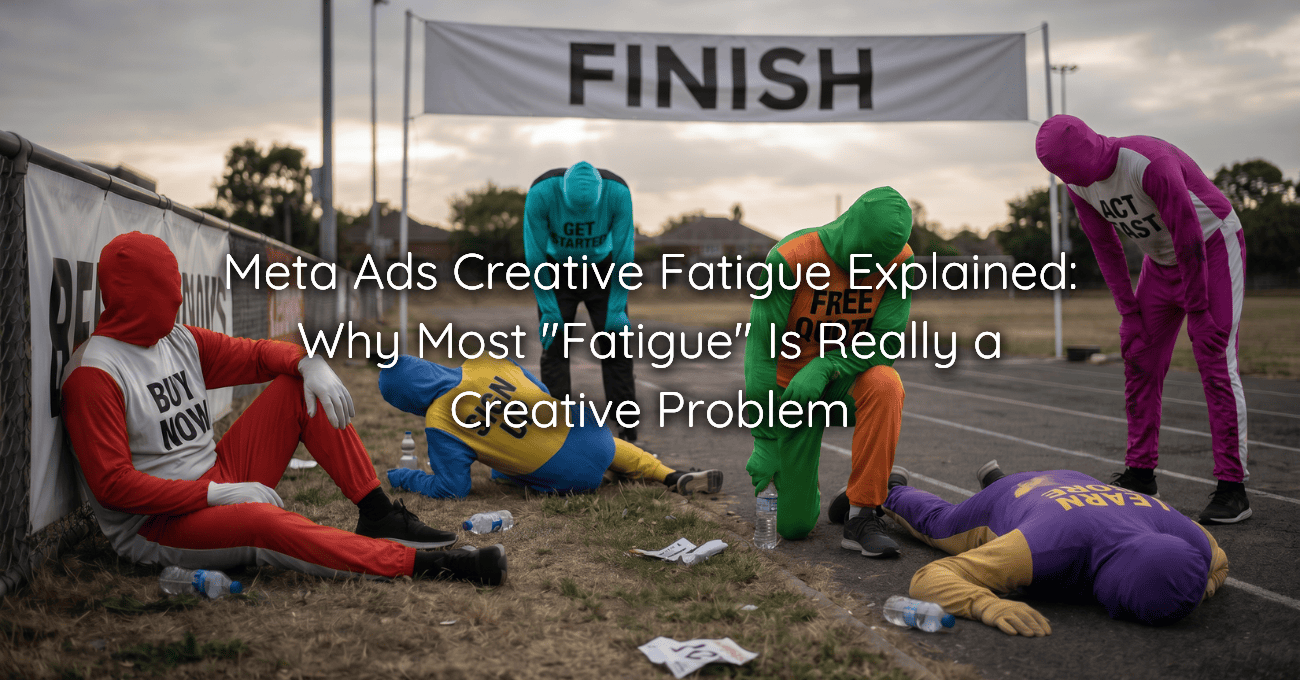
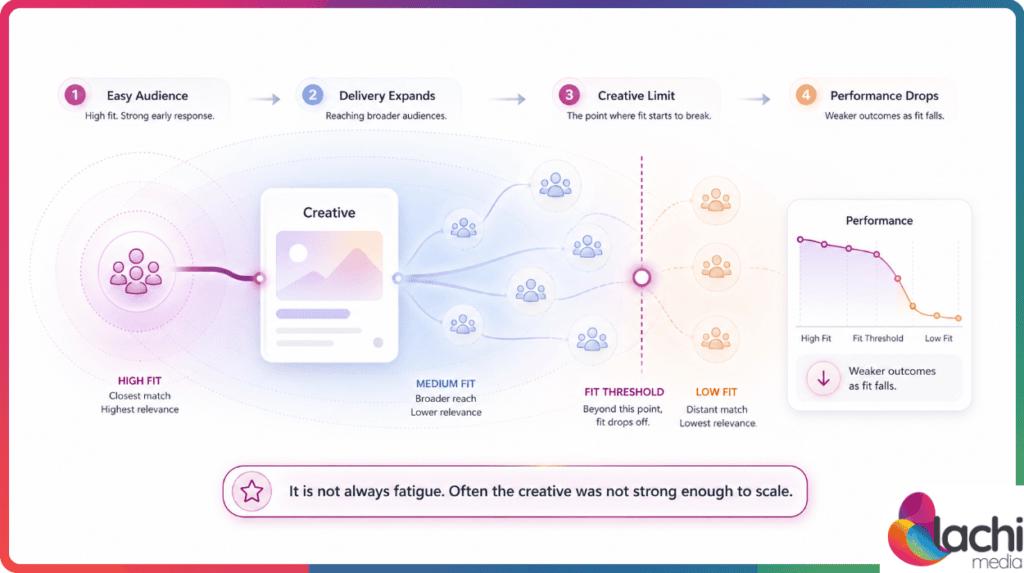
The easy explanation is “creative fatigue”, but in many cases, that explanation is wrong. The ad did not necessarily get old, and the audience did not necessarily get tired of it. Meta may have simply found the easiest audience first, then discovered that the creative was not strong enough to keep working as delivery expanded.
That is the real issue behind most Meta Ads creative fatigue: not true fatigue, but limited creative strength.
TL;DR
Most Meta Ads creative fatigue is not really fatigue. In many accounts, the creative did not wear out; it simply was not strong enough to keep performing as Meta expanded delivery beyond the easiest audience.
A rise in frequency, a softer CTR, a higher CPA, weaker ROAS, or weaker conversion quality does not automatically mean the audience got tired of the ad. It often means the creative worked for the first pocket of users, then failed as Meta tried to find more people.
Good Meta ads can run for months or even years if they continue producing the right business outcomes. The age of an ad is not a problem by itself.
Broad hooks can create false positive signals by attracting attention from people the offer was never likely to convert. A strong hook should attract the right people and filter out the wrong ones.
Bad tracking hides underperforming creative. If Meta only sees shallow conversions, it can learn the wrong lessons and slowly drift toward cheaper, lower-quality volume.
The fix is usually better creative testing, better conversion signals, and better interpretation of the data. Do not replace an ad because it is old. Replace it because the data shows it stopped producing the right outcomes.
What Meta Ads Creative Fatigue Usually Means
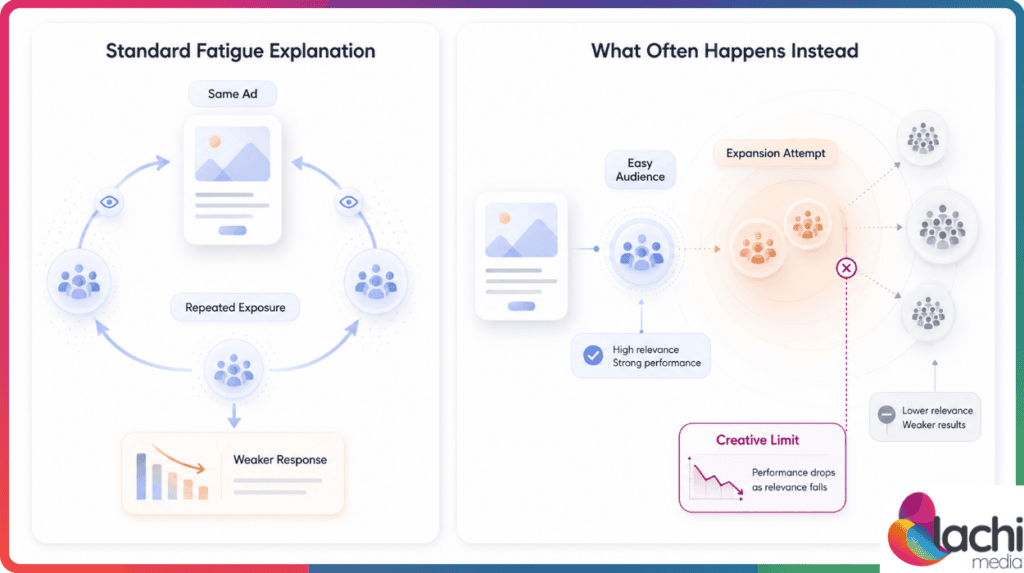
Meta Ads creative fatigue is usually described as a drop in performance after the same audience sees the same ad too many times. That is close to how Meta explains creative fatigue in its own documentation on creative fatigue recommendations.
That definition is useful as a starting point, but it is incomplete in many real accounts. The standard explanation assumes the core problem is repeated exposure: the audience saw the creative too many times, became less responsive, and performance declined.
That can happen in theory, but in many Meta Ads accounts, especially accounts targeting markets that are not extremely niche, true fatigue is much less common than advertisers think. What advertisers call “fatigue” is often something else: the creative worked for the easiest audience Meta could find, then failed as delivery expanded.
The industry will keep using the word “fatigue” because that is the common term. In practice, however, the more useful diagnosis is often creative expansion failure.
The Standard Fatigue Explanation Is Too Simple
The common story is that the ad worked, the audience saw it too many times, the audience got tired of it, performance dropped, and the ad needs to be refreshed. Sometimes that story is true, but it should not be the default diagnosis.
Most accounts do not operate inside a perfectly fixed audience. People enter and leave buying windows all the time, interests change, problems appear, needs become urgent, and users who were not relevant last month can become relevant today.
That is why it is very hard for a strong ad to truly exhaust a healthy market. A good ad can run for a long time because the audience is not static, so if performance is still strong, the fact that the ad has been active for months is not a problem by itself.
Why Most “Creative Fatigue” Is Really a Creative Problem
Most of the time, the core issue is simple: the creative was not good enough. That does not mean the creative was ugly, lazy, or completely ineffective. It may have worked very well for a small group of people.
But working for a small group is not the same as scaling. A creative can perform well at first because Meta starts by finding the users most likely to respond, and that first group is usually the easiest audience.
If the creative is only strong enough for that audience, performance can drop once Meta needs to expand delivery. That is why early performance can be misleading: the ad did not necessarily become worse, but Meta moved beyond the people who were easiest to convince.
The simplified ripple model
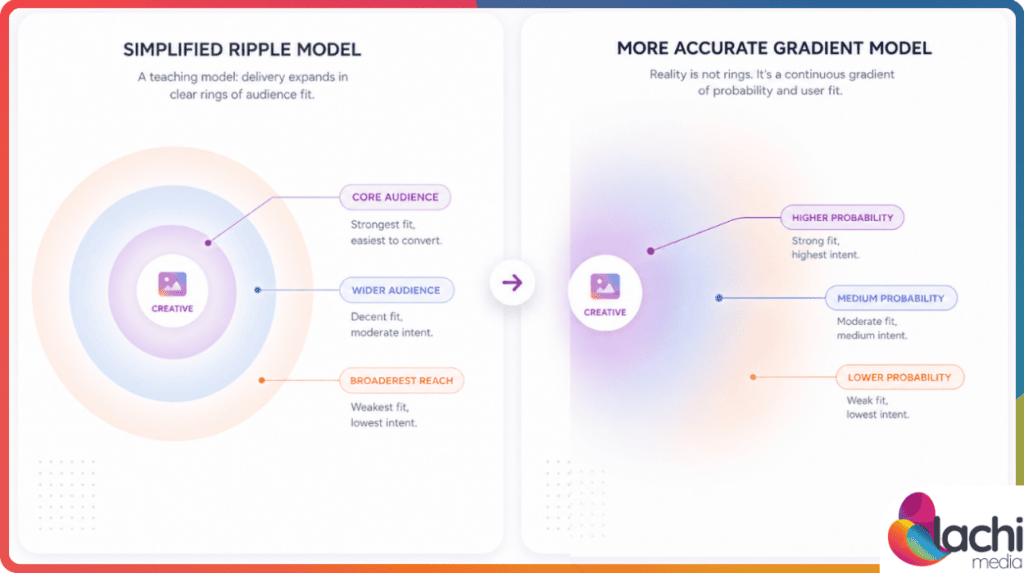
A useful way to explain this is with a ripple metaphor. Imagine Meta starting with the people most likely to respond to a specific ad. That first group is the tightest and easiest pocket.
If the ad works there, Meta tries to expand into a wider circle of users who are still relevant, but less obvious. Then it tries to expand further.
That creates a simple teaching model:
- Small inner group, strongest fit
- Wider group, decent fit
- Broader group, weaker fit
If the creative only works for the inner group, performance drops as Meta pushes further out. That is what many advertisers later call fatigue.
The more accurate gradient model
The ripple model is useful, but it is simplified. Reality is closer to a gradient than to clear audience rings, because Meta is not moving through neat circles. It is dealing with probabilities.
Some people are much more likely to respond well to the ad, some are moderately likely, some are barely relevant, and some will engage but never become valuable customers. Meta is constantly testing how far it can expand while holding performance.
That is why the drop often feels gradual rather than sudden. The system is not hitting a clean wall; it is moving through a changing gradient of user fit.
Why this matters
This changes the main question. The question is not “Did the audience get tired of this ad?” The better question is “Was this creative strong enough to keep working as Meta expanded beyond the easiest users?”
That framing is more useful because it points toward action. If the answer is no, the solution is not to blame fatigue. The solution is to improve the creative system.
Why Audience Targeting Is Not the Main Fix Anymore
Meta still allows targeting controls, but in many accounts, targeting is no longer the main lever advertisers think it is. As Meta relies more on broad targeting and automated delivery, the creative carries more strategic weight.
The creative not only persuades the user. It also helps Meta understand who should see the ad next, which means the creative is doing several jobs at the same time:
- Attracting attention
- Framing the offer
- Filtering the audience
- Sending audience-quality signals back into the delivery system
If the creative is too broad, too vague, or too curiosity-driven, it can send noisy signals. If it is specific and well-filtered, it can help Meta find better users faster.
Meta Andromeda made this harder to ignore
Meta Andromeda did not create this dynamic. It just made it harder to ignore. Meta had already been moving toward more automation, broader targeting, and heavier reliance on creative signals. Andromeda is better understood as another milestone in that shift, not a complete replacement of how Meta works.
As the platform gets better at interpreting behavior and creative inputs, weak concepts hit their ceiling more visibly. That is one reason advertisers should stop thinking about creative as “the ad” and start thinking about it as part of the targeting logic.

The Hook Is Not Just There to Get Attention
The hook deserves special attention because it is often where the problem starts. A lot of advertisers judge hooks by whether they generate a strong reaction, but a hook that gets lots of attention is not automatically a good hook.
If the hook brings in the wrong people, it can make the system learn more slowly and spend more inefficiently. A strong hook should not only stop the scroll; it should help filter the audience.
A good hook attracts and filters
A good hook has two jobs: it should stop the right person, and it should avoid pulling in too many wrong people. That second job is underrated because it is less visible in the ad account than clicks, views, and form submissions.
A broad, dramatic, curiosity-driven hook can create strong early engagement. But if the people engaging are not likely to buy, donate, book, subscribe, or become qualified leads, the hook is feeding Meta false positive signals.
Broad hooks create false positive signals
An overly broad hook can make people watch, click, add to cart, donate a tiny amount, or submit a form. But if those people are not a strong fit for the offer, Meta receives noisy feedback.
That means the system needs more time and more spend to understand who the real audience is. During that learning process, the advertiser may sit with a higher CPA than necessary, weaker ROAS than necessary, or lower-quality conversion volume than the account could have produced with a cleaner signal.
A good creative not only attracts attention, It attracts the right attention and repels the wrong kind.
Example: home improvement lead gen
Too broad
“Most homeowners make this expensive mistake before renovating.”
This can attract almost any homeowner because the hook is built around broad curiosity, not a specific project or buying situation.
Better filtered
“Planning a new deck this year? Here are 3 design choices that can change the final cost.”
This still creates curiosity, but it filters for a much more relevant audience. The ad is more likely to attract people who are actually considering a deck project, rather than homeowners who are simply curious about renovation mistakes.
Example: music ecommerce
Too broad
“This guitar accessory changed everything.”
This can generate curiosity, but it does not give Meta much useful information about the type of player, the problem, or the buying motivation.
Better filtered
“If your pick keeps slipping during fast alternate picking, the problem may not be your technique.”
This speaks to a specific frustration and gives Meta a cleaner signal about who the ad is for. The point is not that every hook must be narrow, but that the hook should create useful attention rather than generic engagement.

The Signals Advertisers Mistake for Creative Fatigue
No single metric proves fatigue. What matters is the pattern, the context, and the business outcome behind the platform metrics.
| Signal | What it usually means |
|---|---|
| CPA rises after a good start | The creative was strong enough for the easiest audience, but not strong enough to expand |
| Frequency starts rising | Meta may be struggling to find new people it trusts with the ad, so it keeps returning to safer users |
| CTR drops | The creative may be less compelling outside the first audience pocket |
| Hook rate stays high, but sales, donations, or qualified leads drop | The hook may speak to a broader audience than the offer actually serves |
| Performance drops after increasing budget | Scaling did not create fatigue. It exposed whether the creative could carry wider delivery |
CPA rises after a strong start
This is one of the most common “fatigue” complaints. In many cases, the ad worked early because Meta was still living inside the easiest part of the audience, then results got worse once the platform needed to spend more broadly.
That does not mean the ad was never good. It means it was not strong enough for scale.
Frequency starts rising
Frequency is a supporting symptom, not a verdict. A rising frequency can mean the system is having a harder time finding fresh users it trusts with the ad, so it keeps leaning back toward users it already considers safer.
That is very different from saying “the audience is tired of the ad”. Frequency matters, but it needs to be interpreted together with volume, CPA, revenue, ROAS, donation value, lead quality, and delivery behavior.
CTR drops
A falling CTR can mean the creative is becoming less compelling as Meta reaches users who are less naturally aligned with the message. That is often a signal of limited creative range, not literal exhaustion.
A weaker CTR can also reflect a mismatch between the hook and the broader audience Meta is trying to reach. The important question is whether the drop is connected to weaker business outcomes, not whether the CTR moved in isolation.
Hook rate stays high, but downstream quality drops
This is especially important because it reveals the difference between attention and useful intent. If the hook continues to create attention while purchases, profitable revenue, qualified leads, closed deals, donations, or donation value become weaker, the creative may be speaking to too many people the offer was never likely to convert.
In that case, the hook is doing its first job but failing its second. It is attracting attention, but not enough of the right attention.
Performance drops after budget increases
Budget increases do not create fatigue by themselves. What they do is force broader delivery, which can expose whether the ad is strong enough to handle scale.
There is not much reason to push serious scale behind a creative that has not proven it can hold quality as delivery widens. Scaling untested creative does not create the problem, but it can reveal the problem faster.
Why Good Meta Ads Can Run for Years
There is no fixed expiration date for a Meta ad. A strong ad can run for months or even years if it keeps producing the right outcomes.
This is one reason true fatigue is much rarer than many advertisers assume. Most markets are dynamic, which means the audience is not a static pool that gets permanently used up in a simple way.
In healthy markets, several things keep changing at once:
- New people enter the category
- Existing people leave it
- Intent changes
- Interest changes
- Life circumstances change
- New buying windows open
A strong Meta ad can continue working for a very long time because it keeps meeting new relevant users as they move into the category. This is especially true in markets with healthy ongoing demand, broad enough audience movement, and strong creative-market fit.
The rule is simple: do not replace an ad because it is old. Replace it because the data shows it stopped producing the right outcomes.

Why Bad Tracking Hides Underperforming Creative
Tracking does not just affect measurement. It affects learning, because Meta can only optimize toward the outcomes it can see.
Bad tracking hides underperforming creative. If Meta only sees shallow conversions, it can make an ad look successful even when the business outcome is weak.
For lead generation, that often means form submissions. For ecommerce, that can mean adds to cart or weaker pre-purchase signals. For nonprofits, that can mean surface-level engagement without enough donation value or donor quality.
The creative may have been underperforming all along. The platform just did not have enough signal depth to show it clearly.
If Meta does not see deeper events, it cannot optimize toward them
This is the bigger problem. If Meta does not receive qualified leads, closed deals, purchase value, donation value, recurring donor quality, or other meaningful downstream outcomes, it cannot learn toward them.
That makes the decline easy to miss, especially when it happens gradually. The system can drift toward easier, cheaper, lower-quality responses while still looking acceptable on shallow platform metrics.
This is one reason good lead generation advertisers should care about value-based thinking, not just raw lead volume. The same core logic discussed in this article on scaling Google Ads lead gen with Maximize Conversion Value and tROAS applies here too: optimize toward the deepest outcome you can report reliably enough and fast enough.
Instant forms are not the problem
Meta instant forms are not inherently risky or bad. In many cases they work very well, and it makes sense that Meta prefers to keep users inside its own platform.
The issue is not the format. The issue is what happens after the form is submitted.
If the account does not report deeper outcomes back to Meta, the platform may optimize toward people who are good at filling forms, not people who are good at becoming customers. That is why instant forms need another reporting layer to meet their potential.
What should be reported back to Meta
For lead generation, deeper events should always be reported back to Meta whenever possible. At minimum, closed deals should be sent back, because that gives Meta a real business outcome instead of only a form submission.
Preferably, advertisers should report both qualified leads and closed deals. Where possible, they should also report conversion value tied to real downstream business outcomes.
Ecommerce advertisers should think similarly. Purchases are much stronger than adds to cart, and revenue is stronger than a simple purchase count. When profit, margin, or customer value can be used responsibly, the signal becomes even more useful.
Nonprofits should also avoid judging creative only by cheap engagement or low-value actions. Donation value, recurring donations, donor quality, and meaningful supporter actions are better signals than surface-level response.
If lead quality is a recurring problem, this also connects naturally to the broader issue discussed in how to stop getting spam leads. Bad lead quality is often not just a sales problem. It is also a signal problem.

Creative Refresh Is Often the Wrong Fix
When performance drops, many advertisers immediately reach for a refresh. Sometimes that helps, but often it does not solve the actual problem.
Execution is not irrelevant. A clearer visual, a stronger edit, a better script, a cleaner headline, or a tighter opening can improve performance.
But execution usually acts as a refiner, not a miracle worker. It is rare for better execution alone to turn a weak concept into a truly scalable winner.
More versions of the same concept are not real testing
This is a common trap. Advertisers create multiple versions of the same basic idea and assume they are testing creative, even when the underlying concept has barely changed.
Those versions often share the same promise, the same hook structure, the same underlying angle, and only slightly different visual treatment or copy. That is not always useless, but it is not the same as testing genuinely different creative directions.
If the original concept only worked for a narrow slice of the market, five more versions of that same concept will usually not solve the core problem. Meta does not need endless versions of the same weak idea; it needs stronger ideas and clearer signals.
What advertisers should do instead?
When performance drops, the useful question is not “Is this fatigue?” The useful question is “What did Meta prove this creative could do, and what should be tested next?”
In practical terms, that usually means one of two things. Either find what did work and multiply it in a meaningful way, or accept that the concept hit its ceiling and test a different direction.
Blaming fatigue is not an action. It only becomes useful once it leads to a better creative test, a better signal setup, or a better interpretation of what already happened.

Different Creative Directions for Different Businesses
Better creative testing does not mean more assets for the sake of more assets. It means exploring different customer motivations, so Meta has genuinely different ways to find valuable people.
Home services
A lot of home services advertisers keep repeating the same general claim, usually some version of “fast, reliable service” or “quality work at a fair price”. That can work, but it often becomes too narrow as a system for testing.
Better directions might include:
- Urgent project need
- Local trust
- Licensed or certified crew
- Before and after proof
- Cost of delaying the project
- Process clarity
The point is not that every home services business needs all of these angles. The point is that each direction gives Meta and the market a meaningfully different reason to respond.
Music e-commerce store
Music ecommerce often suffers from overly generic product-first creative. Showing the product matters, but it is rarely enough by itself.
Better directions might include:
- Better tone
- Easier playing experience
- Gear for a specific genre
- Solving a common player frustration
- Upgrade from entry-level gear
- Pro-level sound without boutique pricing
- Trusted by working musicians
This matters because musicians do not buy only because a product exists. They buy because it solves a sound, feel, identity, frustration, price, or credibility problem.
Nonprofit
Nonprofits often fall into repetitive donation messaging. Repeating “please donate” in new formats is not a strategy.
Better directions might include:
- Direct donor impact
- Urgency of the need
- Transparency
- A personal beneficiary story
- Monthly giving
- Community proof
- What happens if people do not donate
A nonprofit creative system should test different reasons someone might care enough to act. The execution matters, but the core question is whether the creative gives people a clearer reason to support the cause.
How to Fix Meta Ads Creative Fatigue
Most of the time, the fix is not mysterious. It usually comes down to better creative testing, better conversion signals, and better interpretation of the data.
Better creative testing
Advertisers need a system that adds more creative into circulation, but not just more versions of the same weak idea. In many cases, the fastest path is to test creative directions with static images first, then produce videos around the directions that already show real business promise.
This is not a full creative testing workflow, because that deserves its own article. But the principle is simple: test different directions before investing too much into production.
Better conversion signals
Meta should receive deeper events whenever possible. For lead gen, that means qualified leads, closed deals, and ideally conversion value.
For ecommerce, that means purchases and revenue, with profit-aware thinking where possible. For nonprofits, that means donation outcomes and donation value.
The key is to give Meta enough signal depth to distinguish between cheap response and valuable response. Without that, the platform may optimize toward the easiest action rather than the best outcome.
Better interpretation of the data
The question is not “Is this ad fatigued?” The better question is “Did this creative stop working because the audience got tired of it, or because it was only strong enough for the easiest audience Meta found first?”
Most of the time, the answer points back to the creative. The ad either gave Meta enough room to expand, or it did not.