
Last Updated on October 11, 2026
AI Max is worth using more often than not, but not because it is flawless.
It is worth using because it can expand a Search campaign in three places at once: query matching, message generation, and landing-page selection. That can create real incremental lift. It can also create a mess when the campaign structure, website, or conversion setup is weak.
The practical implication is simple: AI Max is not magic, and it is not a minor toggle either. The accounts that usually get the most from it are the ones that give it a clear job, clean inputs, and enough guardrails to expand usefully without drifting into the wrong traffic or the wrong pages.

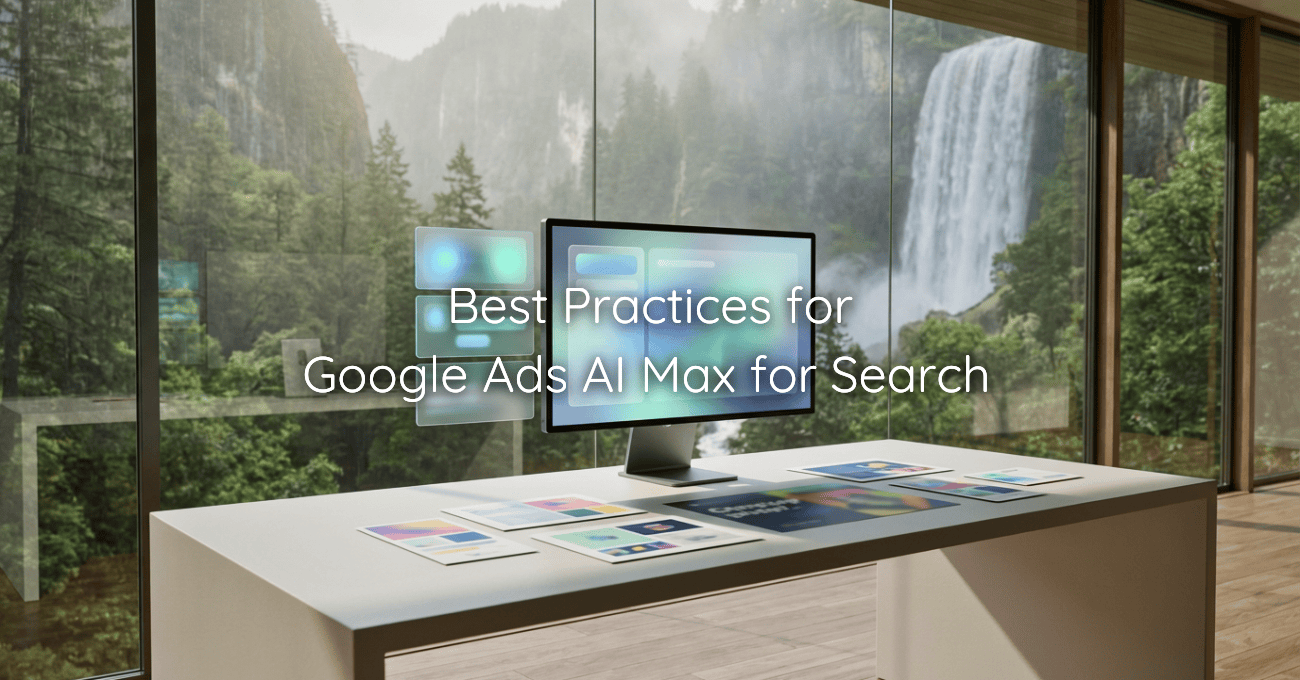
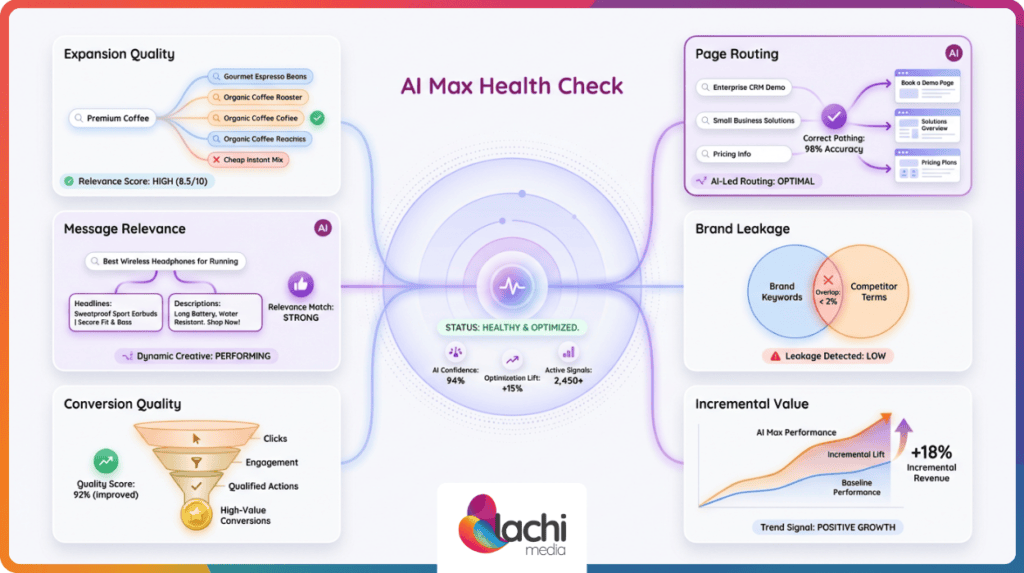
[Caption: AI Max changes how a Search campaign finds queries, adapts copy, and chooses where traffic lands.]
Quick Comparison: Where AI Max Fits
This is the cleanest way to think about the landscape today. AI Max stays inside the Search campaign workflow, while Performance Max remains the cross-channel campaign type, and broad match keywords still serve a different role inside more keyword-led Search structures.
| Option | Usually the better fit when |
|---|---|
| Standard Search | You need tighter keyword, message, and landing-page control |
| Broad match Search | You want expansion, but still inside a more keyword-led workflow |
| DSA | Mostly when there is a specific legacy reason to keep it |
| AI Max for Search | You want broader matching and smarter routing, but still want to work inside a Search campaign |
| Performance Max | You want cross-channel reach beyond Search |
This is the cleanest way to think about the landscape today. AI Max stays inside the Search campaign workflow, while Performance Max remains the cross-channel campaign type.

What AI Max Is and Where It Fits
This section explains what AI Max actually is, where it belongs, and how to think about it before touching settings. That foundation matters because bad optimization often starts with the wrong mental model.
1) Define AI Max correctly before you try to optimize it
AI Max is not a campaign type. It is a Search-campaign feature set. That sounds obvious, but a lot of bad strategic decisions start by getting this wrong. If you think you launched a new campaign type, you will judge it the wrong way. If you understand that you expanded a Search campaign’s matching, messaging, and routing logic, the right optimization questions become much clearer.
The reason this matters is that AI Max does not replace Search strategy. It sits on top of it. A confused campaign stays confused. A weak site stays weak. A shallow conversion signal stays shallow. AI Max just scales the consequences faster. That is why the best AI Max accounts usually already have a clean idea of what each campaign is supposed to do, much like with Performance Max optimization, where the quality of the inputs matters more than random interface tweaks.
2) Decide what job the campaign is supposed to do
Before enabling AI Max, define the campaign’s role in the account. Is it supposed to defend brand, expand non-brand reach, capture long-tail product demand, improve routing to deeper pages, or find adjacent service intent? AI Max does not answer that for you.
This is one of the simplest ways to make the feature easier to judge. A non-brand growth campaign can tolerate more expansion. A tightly controlled campaign built around strict offer language or strict page control usually cannot. The point is not to force one rule across the account. The point is to make sure the level of automation matches the job of the campaign.
3) Use AI Max where expansion is useful, not where rigid control is the point
AI Max can broaden how a Search campaign finds and routes traffic. That is useful when discovery is part of the campaign’s job, but much less useful when strict control is the main value of the campaign.
In practice, AI Max is usually strongest in campaigns where additional relevant demand is more valuable than strict predictability. Think larger product categories, broader service campaigns, or campaigns that need more useful query coverage without leaving Search. It is usually a weaker fit where the campaign depends on exact semantics, fixed message order, or rigid landing-page logic. That is not a contradiction. It is simply good campaign design, and it is also why comparing AI Max to broad match keywords can be useful.
Build the Right Foundation Before You Turn It On
This section covers the basics that need to be solid before AI Max gets a chance to expand anything. Most disappointing AI Max results come from weak foundations, not from the feature itself.
4) Fix conversion quality before you judge AI Max
This is the most important best practice in the article.
AI Max can only optimize toward the signal it is given. If the campaign is teaching Google that every form fill, weak phone call, or shallow micro-conversion is equally valuable, AI Max will learn exactly the wrong lesson. For lead generation, that usually means looking beyond raw lead volume and feeding back stronger business signals such as qualified leads while also reducing noise from spam leads.
For ecommerce, it often means being honest about whether revenue alone is enough, or whether margin, category mix, or new-customer value matter more. AI Max often looks better once the account gets better at defining what a good outcome actually is.
5) Clean up landing pages before you let AI Max expand routing
AI Max does not just expand matching. It can also expand where traffic lands. That means the quality and structure of the site become part of the optimization process.
If category pages, service pages, and product pages are clear and distinct, AI Max has something useful to work with. If the site is full of thin pages, weak commercial pages, outdated promo pages, or vague service summaries, AI Max has more room to make bad routing decisions. Treat Final URL expansion like landing-page automation, because that is what it is, and judge it through the lens of the full sales funnel, not just the click.
6) Make sure campaign and ad group structure can support automation
Search term matching, text customization, and landing-page selection all rely on the campaign’s underlying structure. If the structure is messy, AI Max has more room to be technically relevant while still being commercially wrong.
A tightly themed ad group gives AI Max a better chance of making three good decisions at the same time: matching the right query, generating the right message, and selecting the right page. A messy ad group gives it too many ways to go off course. Tight does not mean tiny. It means the likely queries, the message, and the eligible pages still belong in the same semantic bucket, which is still closely tied to classic ideas like Quality Score, ad relevance, and landing-page experience.

Keep Query Expansion Useful
This section focuses on how to let AI Max expand without letting it drift. The goal is not to stop expansion, but to make sure the extra reach is actually useful.
7) Let search term matching expand only where the upside is real
More matching is not automatically better. It is only better when the likely gain in useful query coverage is larger than the likely gain in expensive noise.
Broad category campaigns, non-brand growth campaigns, and large service campaigns often have room for this. Tight offer campaigns, compliance-sensitive campaigns, and campaigns built around exact routing often have far less room. The right principle is not “always expand”. It is “expand where additional relevant demand is more likely than additional expensive noise”.
8) Use brand controls and negatives to create swimlanes, not to satisfy anxiety
AI Max needs room to work, but that does not mean it should ignore account structure. Brand controls and negatives should be used to keep different campaign jobs from stepping on one another.
Use them to protect a dedicated brand campaign, separate competitor logic from generic prospecting, or keep different budgets, goals, and landing-page strategies in their own lane. What usually backfires is using negatives just because expansion feels uncomfortable. AI Max needs room to prove itself, but it still needs boundaries where the account has genuinely different jobs to perform, especially in service businesses where tighter structure often matters more than people think, as in many Google Ads campaigns for local service businesses.
9) Keep ad groups semantically tight so AI Max has less room to misread intent
AI Max can only make good decisions consistently if the campaign structure gives it a fair chance. The looser the ad group theme, the harder it becomes to understand why something matched, why a certain message showed, and why traffic landed on a specific page.
The practical test is simple: if a human looked at the ad group and had trouble explaining which queries, messages, and pages truly belong together, AI Max will probably have trouble too. Strong AI Max setups make that logic easier to see, not harder.
Keep Messaging Relevant
This section is about making sure AI Max says the right thing, not just something plausible. Better matching and better routing still fall apart when the message is weak, vague, or off-brand.
10) Use text customization only when your site gives it something good to work with
Text customization is only as good as the inputs behind it. If the site is clear, differentiated, and commercially sharp, AI Max has something useful to build from. If the site is vague or generic, AI Max can generate cleaner versions of weak positioning.
That is why this setting is less about trusting AI and more about trusting the quality of the website and campaign inputs, which overlaps heavily with fundamentals like Quality Score, ad relevance, and landing-page experience.
11) Review AI-generated messaging like an operator, not like a spectator
AI Max should not be treated as a copy generator you glance at once in a while. It should be treated like part of the campaign that needs regular review.
The questions are straightforward: Is the message accurate? Is it persuasive? Does it match the page it was paired with? A message can be technically correct and still be weak. It can be relevant and still feel off-brand. The point of AI Max is not to remove judgment. It is to create more relevant combinations while keeping human review in the loop.
12) Use AI Max more carefully when message control matters a lot
Some campaigns need more freedom. Others need more control. That is especially true when the campaign depends on strict message order, tight claim structure, or sensitive language.
In those situations, the right best practice is not forcing full AI Max adoption. It is preserving the amount of control the campaign genuinely needs, even if that means limiting rollout or using fewer AI Max components in that campaign.
Keep Landing Page Expansion Under Control
This section focuses on one of the most misunderstood parts of AI Max: page selection. A lot of so-called traffic-quality problems are actually landing-page problems in disguise.
13) Treat Final URL expansion as landing-page automation, not just reach expansion
Final URL expansion is not just a reach feature. It is a routing feature. That distinction matters because the page choice can make or break whether a query becomes a good click or a wasted one.
This is why the setting feels excellent in some accounts and chaotic in others. If the site has strong category depth, strong service pages, and clear page intent, the setting can improve relevance. If the site is repetitive, commercially messy, or full of weak near-duplicate destinations, the same setting can push traffic into the wrong places while still looking relevant on paper. The right way to judge that tradeoff is through the actual sales funnel, not just through top-line click volume.

14) Protect pages that should never receive paid traffic
Some pages should never be eligible for AI Max traffic, even if they are technically related to the query. That is where exclusions stop being cleanup and start becoming part of routing strategy.
The obvious examples are careers, support, policy pages, and blog content. The more important examples are often commercial-looking pages that are still the wrong destination, such as broad umbrella pages, outdated location pages, or top-level service pages that are weaker than a better subpage. The point is not just to remove bad pages. It is to guide AI Max toward the pages that actually deserve the click.
15) Judge AI Max by the full journey from query to message to page
This is one of the most useful diagnostic habits in AI Max. Do not judge the click in isolation. Judge the full journey.
When performance is weak, ask what AI Max misunderstood: the query, the message, or the page. A good query can fail with the wrong page. A good page can fail with the wrong generated message. A good message can fail because the underlying query never belonged in the campaign. The best optimizations usually start once you identify the layer that actually broke.

Optimize the Account, Not Just the Setting
This section is about avoiding shallow optimization. AI Max usually improves more when the account gets better than when the settings panel gets busier.
16) Match bidding logic to signal depth, not platform excitement
AI Max works best when the account can feed a useful enough signal into automated bidding. That does not mean using the fanciest setup possible. It means using the deepest signal you can actually defend.
If you only trust lead volume, optimize around that carefully. If you can import qualified leads or sales-stage data, do that. If you have reliable value, optimize to value. AI Max usually looks better when the bidding logic matches the real quality of the signal instead of the most sophisticated-looking setup in the interface, which is the same core logic behind stronger automated bidding strategies and deeper-funnel approaches like Maximize Conversion Value and tROAS.
17) Judge AI Max by incremental value, not raw volume
The wrong question is “Did conversions go up?” The better question is “What did AI Max add that the campaign was not already getting efficiently?”
That might mean new converting search terms, better routing, stronger non-brand coverage, or more valuable traffic. It might also mean more noise. AI Max gets easier to evaluate once you hold it to an incremental standard instead of a headline-metric standard.
18) Give AI Max enough stable time before you start fixing it
One of the easiest ways to misread AI Max is to intervene too early. Monitoring is important. Constant correction is not the same thing.
Watch closely. Document patterns. Review search terms, messages, and pages together. But do not assume every odd match in the first few days is a structural failure. The strongest AI Max managers tend to be the ones who let the system reveal its pattern before deciding how and where to constrain it.
Frequently Asked Questions
Is AI Max a campaign type?
How is AI Max different from standard Search, broad match, DSA, and Performance Max?
When is AI Max a better fit than standard Search?
When is AI Max a good addition to other campaigns?
Does AI Max respect negative keywords?
Does AI Max respect pinned assets?
When should Final URL expansion be turned off?
How should lead generation accounts evaluate AI Max?
How should ecommerce accounts evaluate AI Max?
What is the biggest mistake advertisers make with AI Max?
Final Thoughts
AI Max is usually worth testing and often worth keeping, but it works best when it is treated like a layer of controlled expansion rather than a shortcut. If the campaign has a clear job, strong pages, good signals, and the right boundaries, AI Max can add real value. If those basics are weak, it will usually expose the weakness before it fixes it, especially when low-quality or spam leads are still shaping what the system learns from.